Learning Through Research and Daily Life: Singapore Training Program
Singapore
Kotone Tanaka, 3rd Year, Department of Materials Science and Engineering
Study Period: Tuesday, August 19—Monday, September 22, 2025
I participated in an overseas training program in Singapore for about one month. The university where I stayed was very spacious, with well-equipped research facilities. The laboratory contained many experimental instruments, including 3D printers. I still remember being amazed the first time I entered the lab, seeing shelves filled with intricate 3D-printed models. The campus also had several cafeterias where I could enjoy multicultural cuisine unique to Singapore. The professors were kind and provided detailed guidance on laboratory use and experiments, which allowed me to conduct my activities with confidence.
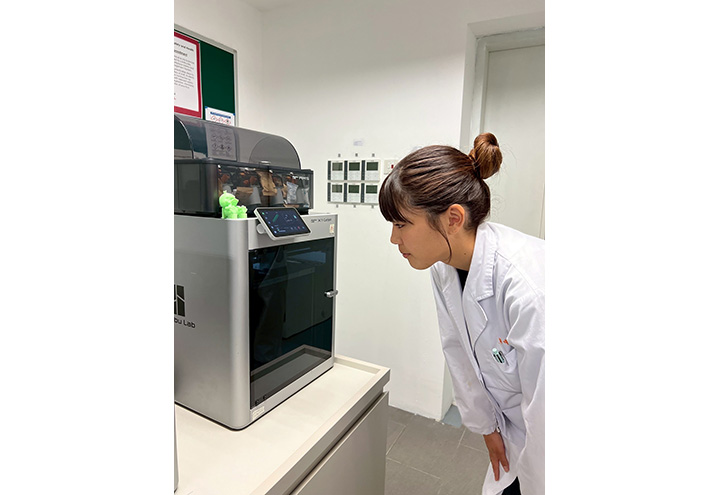
Using a 3D printer
During the program, I worked on designing and improving a coil device to remove microplastics using a 3D printer. Initially, I faced many challenges such as being unable to create the intended shapes and obtaining unexpected experimental results. However, by learning from these failures, I gradually achieved better outcomes. For example, I discovered that changing the coil’s cross-section from round to square increased the static electricity, allowing more plastic particles to be collected. I also conducted comparative experiments using tap water and saltwater and confirmed that the removal efficiency varied depending on the conditions. Repeating these experiments taught me the importance of precise measurements and data organization, and I experienced the joy of continuous improvement through research.
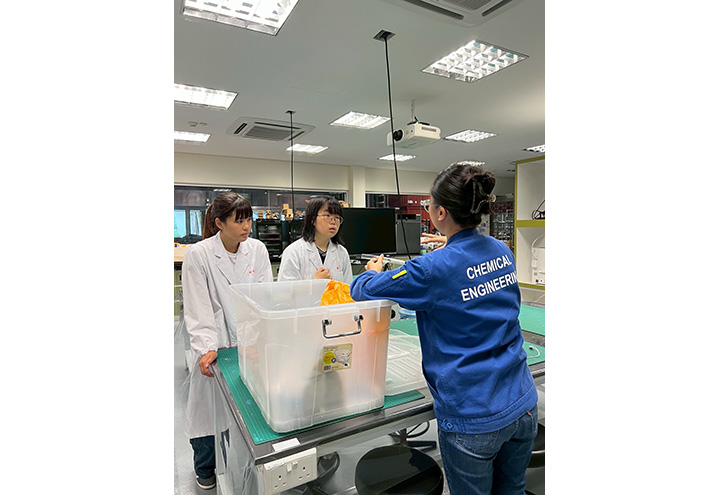
Experiment in progress
Local students provided significant support, taught me how to use the laboratory equipment, and answered questions patiently. Working together on the research helped me understand the importance of collaboration. On weekends and after school, I visited Singapore’s iconic landmarks such as the Merlion, Gardens by Bay, and an aquarium on Sentosa Island. In shopping malls, I encountered foods and goods rarely seen in Japan, giving me a strong sense of cultural differences. Walking through Little India and Chinatown, I observed how religion and culture were reflected in the streetscapes, experiencing the unique atmosphere of a multicultural society.

Merlion sightseeing
I stayed in a student dormitory and shared meals and daily necessities with friends. I mostly ate at hawker centers and enjoyed affordable multicultural dishes, including spicy foods and dishes that are unfamiliar in Japan. Asking the locals for recommendations was also a memorable experience. I noticed cultural differences such as utensils being separated by religion in cafeterias and strict environmental rules across the city. Language was sometimes a barrier, as Mandarin, Malay, and other languages were commonly spoken in addition to English, but I learned the importance of using simple English and gestures to communicate.
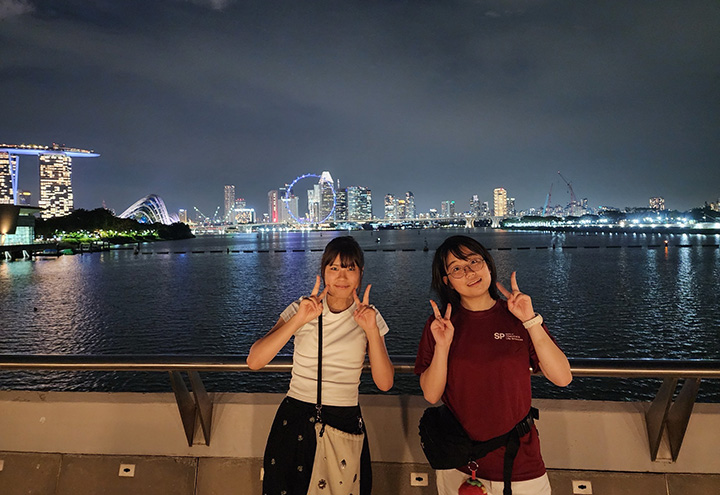
Night view of Singapore
Over the course of this month, I learned from research the importance of “not fearing failure and continuously improving,” and from daily life, the value of “accepting other cultures and cooperating with others.” Completing the program, supported by professors and students gave me confidence. Living in a multicultural society has also helped me develop the ability to interact with people across cultural and linguistic boundaries.
I am confident that the knowledge and experiences gained during this study-abroad program will be invaluable for my future career and research. My time in Singapore was not only an unforgettable memory but also an opportunity for personal growth. This strengthened my determination to face new challenges fearlessly and embrace new environments.
To the top