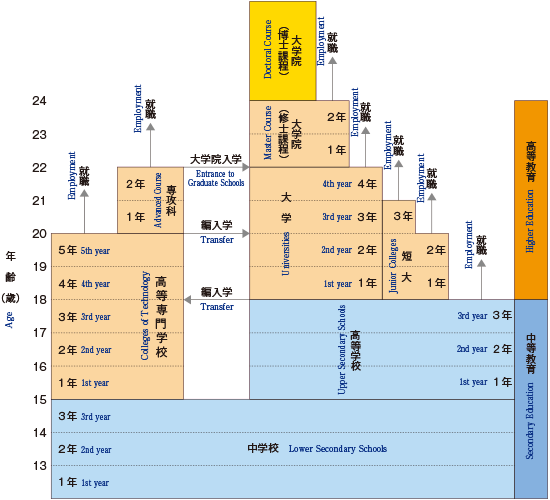
- Technical colleges are five-year high-education institutions that seek to train topflight technical specialists. An integrated five-year program enables the student to study efficiently both general education and specialized subjects at high school and university level, to receive an education equivalent to that at the university level, and to engage in research.
- This system was put in place in 1961, and 12 National Institute of Technology were established in 1962. At present there are a total of 51 National Institute of Technology in Japan.
- The system has played an important role in training the technical specialists of Japan and thus far prepared over 400,000 graduates for entry into society.
- Active research is carried out in order to promote cooperation with local industries. The schools also make an active effort to establish themselves as open, and easily accessible higher-education institutions by serving as a base for continuing education in the local communities, offering extension courses open to the public and providing systems for accepting research students, auditors, etc.
- Graduates of the regular five-year program at a College of Technology (KOSEN) are awarded the title of Associate, which is a qualification conferred upon completion of KOSEN education.
Under the School Education Act of Japan, graduates of a College of Technology (KOSEN) may obtain a Bachelor’s degree by completing the required credits in an advanced course at a KOSEN, by taking courses as a non-degree student at a university, or through other approved study programs, and then applying to the National Institution for Academic Degrees and Quality Enhancement of Higher Education (NIAD-QE). If they successfully pass the assessment conducted by NIAD-QE, they may be awarded a Bachelor’s degree by NIAD-QE.